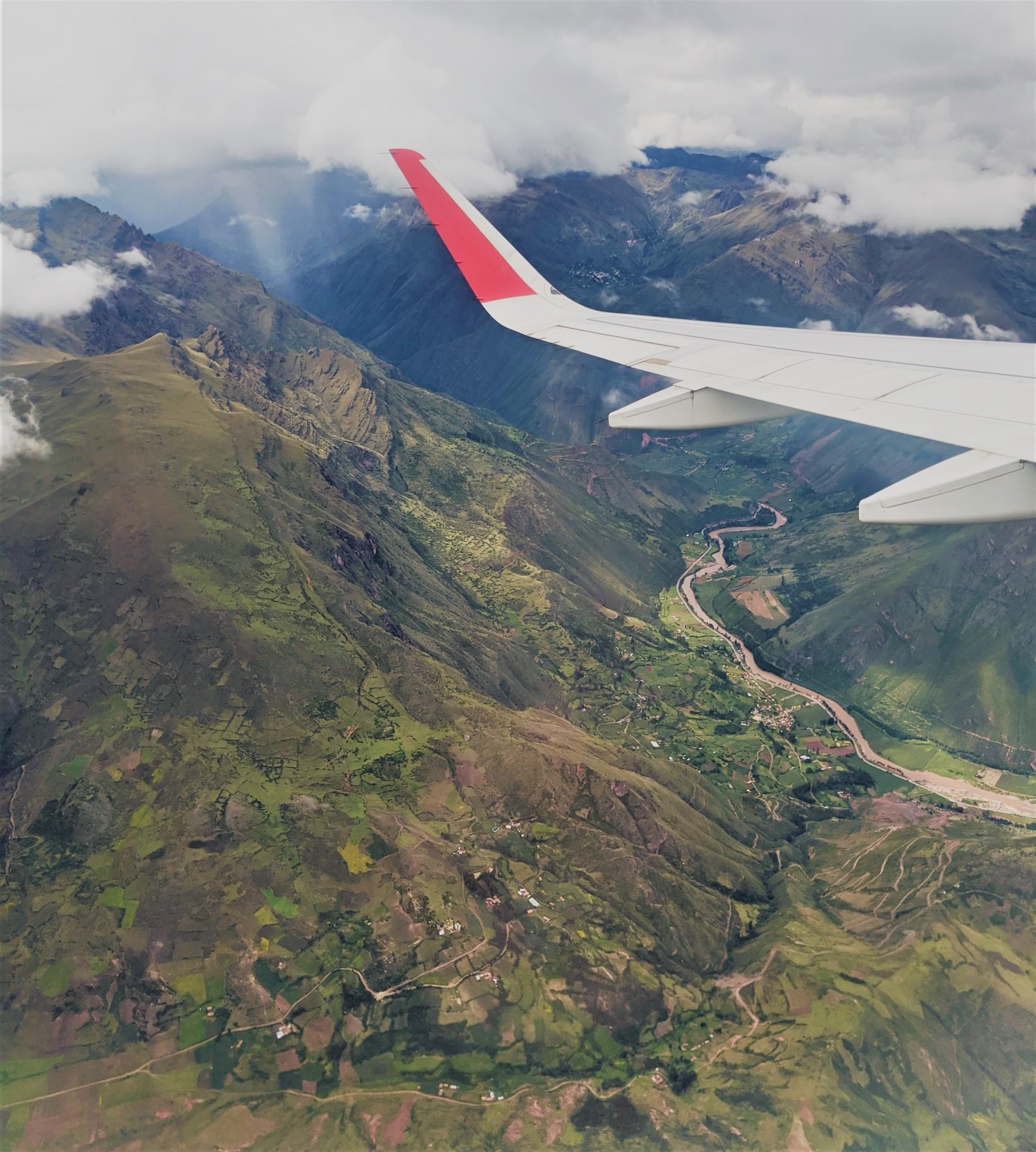
Destination: Southern Peru
Cities visited: Lima, Paracas, Huacachina, Arequipa, Puno (Lake Titicaca), Ollantaytambo and Cusco
If I had one fault as a human being….
it would be that I’m not great at masking my thoughts and emotions. Bought me a gift I’m not super into? Sorry, you’ll know right away even as I try to insist I love it. So, when my partner offers to drive us back East for family visits, there’s no doubting my hesitation.

It’s not that he’s a bad driver. He’s just not me. And even though I’m no better of a driver than he is – and I’m sure even those without travel anxiety can relate – I hate giving up control.
For this reason, I dislike most modes of public transportation. Whenever I think I’m getting comfortable with one – the bus system in Pittsburgh, where I currently live, for example – a bus suddenly falls into a sinkhole in the middle of downtown and my resolution to be carefree is shook once again.
My partner and I settled on Peru for our first international adventure together for a few reasons:
- Neither of us had been there
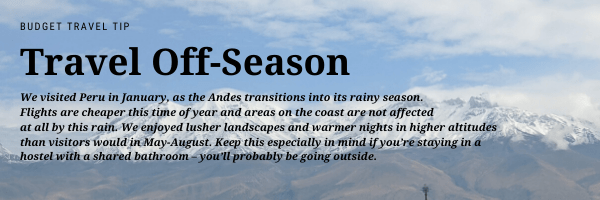
- It was off-season there, so prices were cheaper
- Machu Picchu is a thing
All was hunky-dory until I hunkered down to plan. I started my array of beloved spreadsheets of places we could visit … and here’s where the travel anxiety kicked in.
Peru is much larger than I knew. Many of the places I wanted to see were “just a short plane ride” from Lima, or “an overnight bus” from Cusco. Gulp. To traverse our way around the country, we ended up using far more modes of transportation than anticipated. Here, I’ve broken down the anxiety levels I had anticipating each mode and the actual scare level once I was on it:
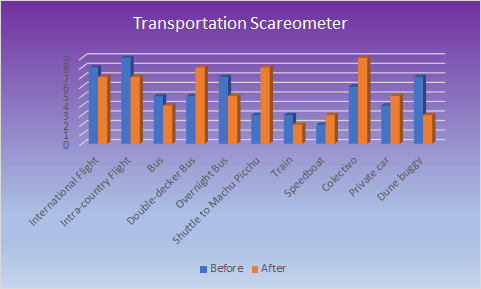
Today I’m going to cover our experiences in air travel to and around Peru, including information on the airport in Cusco and something I wish I’d known before our flight back to the U.S. Don’t worry, though, I’ll cover land travel in an upcoming post and the more exotic modes of transport like trains and boats as they relate to travel activities.
Flights, or,
my nostalgia for complimentary cranberry juice
International
As we were on a budget, we went with Spirit Airlines for our international flight from Pittsburgh to Lima, Peru, via a layover in Fort Lauderdale, Florida. Every budget traveler in the United States recognizes the bright yellow planes as they carry budget-conscious travelers through the air to exotic and not-so-exotic destinations. Much likes its U.S.-domestic-only competitor, Frontier, flyers sacrifice comfort for budget when flying Spirit. However, we were able to upgrade our package to include seat selection, priority boarding, carry-ons, and checked bags for less than the next-lowest airline (JetBlue).
What we sacrificed:
Leg room – This doesn’t necessarily apply to my partner and I, both of whom are under 5’4”, but I had sympathy for the taller-than-average father of three behind us who crammed himself in to sit beside his family instead of paying for the upgraded, reasonable leg room seats up front. But really, there shouldn’t be a tax for being tall.
Complimentary beverages and snacks – My flights never feel complete without my tiny cup of cranberry juice, and I’ve been sad to cut it out of my routine when flying budget airlines like Frontier and Spirit. However, I refuse to pay for ballpark-price drinks unless I’m in a ballpark (Go Phils!). It seems shady to me that they can lock you in an airplane for hours and not offer at least water free. Even ballparks will give you some tap water if you ask. Normally this isn’t really a problem, though, because you bring on a water bottle and snack and you’re good.
But here’s the problem: On flights from Lima’s Jorge Chavez International Airport to the United States, all liquids over 3.4 ounces (100 ml) are banned, even those bought after security. No water bottles allowed. After a 5.5-hour red-eye flight to Fort Lauderdale, Florida, I woke up cotton-mouthed and still had to get through more than an hour in customs before rushing to buy a $10 water bottle in order to catch our imminent connecting flight to Pittsburgh.
If we did it again? I’d get a different airline home that offers my treasured cranberry juice.
Domestic
We had only one domestic flight in Peru, though many people I know have at least two if they choose to bypass the coast and fly straight Lima to Cusco and Machu Picchu (While my gut is to ask Why would you want to bypass all the beautiful places in between?, this route would cut down on costs and time, if either are of major concern. But beware altitude if you go this route.).
We flew LATAM (formerly LAN) Airlines, Latin America’s largest airline, on our flight from Cusco to Lima, an hour and a half flight time. When we flew out of Cusco’s pocket-sized, inner-city Alejandro Velasco Astete Airport, the only flights we saw were for LATAM. I have heard that many of the other domestic airlines use smaller planes that are regularly grounded during the rainy season, allowing LATAM to have the monopoly that time of year. But I’m not complaining. The plane was comfortable and the staff professional.
Their food and beverage services vary per type of flight, but they do offer free access to a range of entertainment through their LATAM app. Ticket prices could be hefty during prime departure times in the morning and evening, but we snagged tickets for 33USD per person mid-afternoon. This worked for us, but if you’re stacking flights, take note that many international departures out of Lima are late at night, so you may end up with a lot of time to kill at the airport.
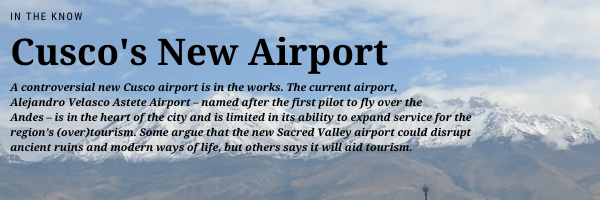
Traversing Alejandro Velasco Astete Airport
Those with airport anxiety can take note of a few things about Cusco’s regional airport.
Positives:
- I’m not kidding when I say Alejandro Velasco Astete Airport is tiny. Fear not, directionally-inept friends – there’s no getting lost here.
- For off-season travel, getting through security was a breeze. In fact, we’d been told to get there two hours ahead and needed only about a half hour for ticketing and security (though my anxiety is of the better safe than sorry mindset). *This would most certainly not be true during peak season travel*
Negatives:
- We were there during the relative quiet of off-season and the crowds pushed the comfort level of closeness at times, especially considering South American personal space is not the same as U.S. personal space. For those anxious in large crowds, peak travel in May-September may be overwhelming.
- Because the airport in Cusco is so small, airport walkers and explorers won’t have far to go. Stake out a seat and don’t let it go; make sure you bring a stationary activity.
- Our flight didn’t pop onto the departure screen until 15 minutes before boarding. As a habitual screen checker, this heightened my anxiety. Was the flight canceled? Delayed? Where should we be boarding?! According to an employee, this is typical and it really didn’t make a difference because all of the gates appeared to be in the same corridor.
One more thing:
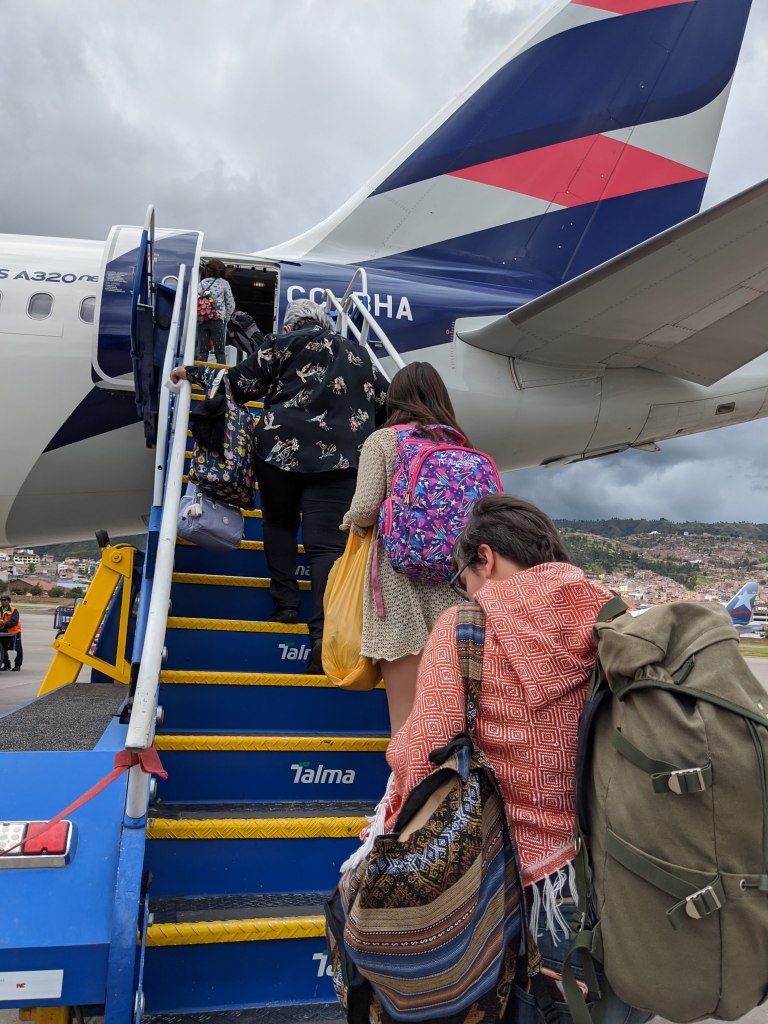
We boarded our plane from the tarmac! This was my first time doing this and I found it pretty exhilarating. Boarding from the runway had one great benefit though because we boarded the plane from two ends, depending on where our seat was. Boarding was quick and comfortable.
The Wrap-up
Hopefully some of the travel tips above can help you plan your Peru getaway. Traveling with anxiety is not only possible, but beneficial. It can be way too easy to get stuck in our comfort bubble and there were many times I wanted to throw in the towel. But you know what? Once we got going, my curiosity took over. Scared of flying up until the moment we take off, I become infatuated with the visual definition of clouds when they are at eye level. Terrified of being in a country with limited language, I suddenly become invigorated by the challenge of communication when language is thrown out.
Check out my next post for five tips for battling anxiety while flying. Then, we have plenty more to explore from my trip to Peru. We’ll take a look at some domestic destinations in the coming weeks, as well. Keep an eye out for new content and tips for travel.
 The Scaredy-Cat's Guide to Travel